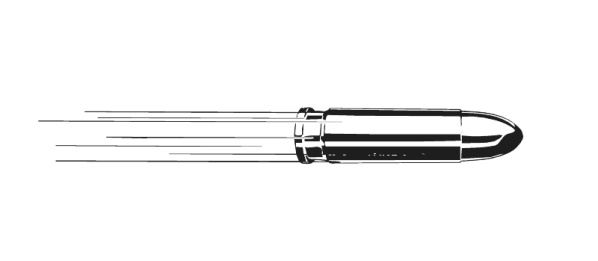
An intended message is directly received and totally accepted by the receiver. This model was originally rooted in 1930s behaviorism at very beginning of the mass media age.
Originate from Lasswell (1927).
It was based on early observations of the effect of mass media, as used by Nazi Propaganda. People were assumed to be “uniformly controlled by their biologically based instincts and that they react more or less uniformly to whatever stimuli come along”.
The media’s message is a bullet fired from the “media gun” into the viewer’s head. Receivers are passive and defenseless (that’s why this theory is also called Bullet Theory)
This model think that media injected values, ideas and information directly in the mind of audience and it was focused on the negative effects caused by media.
The weakness of this model is that audiences are seen as passive and malleable with no thought of their own.
The bullet theory still holds significance in the digital age, since the audience members actively decide which social media platform to use and, depending on the nature of the story, passively react to contents they are exposed to (Nwabueze and Okonkwo, 2018).
The social media have also widened the scope of human interaction and make for user-generated content and social presence. This adds to the powerful effect of the media, depending on the issue involved.
Jowett and OʼDonnell (2012) stated that the modern form of “Magic Bullet” theory could be view in an unintentional advertising by corporations: for them advertising is “a series of appeals, statements and symbols intentionally schemed to either influence the receiver of the message towards the point of view and act in some precise way or maintain a memory in the mind of the audience”.